





Ergonomic Office Workstation Buying Guide for Manufacturers
- Ergonomic Office Workstation Buying Guide for Manufacturers
- Why ergonomic workstation office design matters to manufacturers
- Understanding buyer intent for workstation office purchases
- Core ergonomic principles every workstation office should meet
- Product types for the workstation office: pros, cons and specifications
- Materials, finishes and sustainability considerations for a modern workstation office
- Safety, compliance and certifications relevant to workstation office products
- Design for manufacture and assembly (DfMA) for workstation office efficiency
- Quality control, testing and warranty strategies for workstation office products
- Cost vs. value: pricing workstation office solutions
- Customization and international projects: localization for a global workstation office market
- Case example: choosing components for a mid-range ergonomic workstation office
- How to present workstation office solutions to procurement and design teams
- Manufacturing partner checklist for buyers of workstation office systems
- MEI YI Furniture: a partner for ergonomic workstation office manufacturing
- MEI YI’s main products and core capabilities for workstation office projects
- MEI YI competitive strengths summarized for buyers evaluating workstation office suppliers
- Comparison table: MEI YI production specs for procurement decisions
- Implementation checklist for manufacturers launching a workstation office line
- Frequently Asked Questions (FAQ) about workstation office buying and manufacturing
- Contact MEI YI — request samples or project support for workstation office solutions
- Sources and references
Ergonomic Office Workstation Buying Guide for Manufacturers
Why ergonomic workstation office design matters to manufacturers
As a manufacturer, your decisions about ergonomics influence product performance, customer satisfaction, liability, and brand value. A workstation office that prioritizes ergonomics reduces workplace injuries, increases productivity, and supports long-term client relationships. Buyers — ranging from corporate procurement teams to interior designers and facility managers — expect solutions that are adjustable, durable, certified, and easy to install. This guide focuses on practical, actionable information manufacturers need to design, produce, and market ergonomic office workstations.
Understanding buyer intent for workstation office purchases
Buyers looking for a workstation office solution typically have one of three intents: replace/upgrade existing furniture, outfit a new office/project, or procure custom-made solutions for niche requirements (healthcare, education, hospitality). Each intent carries different priorities: cost and lead time for replacements, scalability and warranty for new office rollouts, and customization and compliance for niche projects. Manufacturers must align product specifications, modularity, and service offerings (CAD/3D, samples, warranties) to match these intents.
Core ergonomic principles every workstation office should meet
Ergonomics translates human needs into measurable design criteria. Core principles for a workstation office include:
- Neutral posture: allow a neutral spine, relaxed shoulders, and wrists in a straight line.
- Adjustability: enable seat, desk, monitor, and accessory adjustments to fit a wide anthropometric range.
- Reach zones: place frequently used items within easy reach to minimize repetitive strain.
- Visual ergonomics: manage monitor height, distance and glare to reduce eye strain.
- Movement: encourage position changes (sit-stand options, break reminders) to reduce prolonged static loading.
Design specifications should be translated into clear manufacturing requirements and test criteria, so each workstation office product consistently meets ergonomic expectations.
Product types for the workstation office: pros, cons and specifications
Manufacturers often produce several workstation office formats. Choosing which to offer depends on your market and production strengths. The table below compares common types and manufacturing considerations.
| Workstation Type | Pros | Cons | Manufacturing Considerations |
|---|---|---|---|
| Fixed-height desk | Cost-effective, simple assembly, stable | Less adjustable for different users; potential obsolescence | Focus on durable materials, edge finishing, modular tops for easy SKU variants |
| Height-adjustable (electric/manual) sit-stand | Supports movement, broad market appeal, higher margin | Higher complexity & cost; requires quality actuators and testing | Partner with reliable motor suppliers; provide range-of-motion specs and load testing |
| Benching systems | Efficient use of space; modular; scalable for large rollouts | Requires coordination for cable management and privacy accessories | Design for tool-free assembly, integrated wiring channels, and acoustic options |
| Pods & privacy units | Higher perceived value; fits modern hybrid workplaces | Higher production complexity; niche market | Invest in acoustic materials, precise assembly, and surface finishing |
Source: industry product benchmarking and manufacturer case studies (see cited sources below).
Materials, finishes and sustainability considerations for a modern workstation office
Material selection affects durability, aesthetics, cost, and compliance. Key considerations:
- Worktops: E1-grade MDF/particleboard with high-pressure laminate (HPL) or veneered plywood offer a balance of cost and finish quality. For High Quality lines, solid wood or engineered wood veneers can be used.
- Frames: steel frames (powder-coated) or extruded aluminum provide strength for adjustable desks and benching systems.
- Acoustics & screens: recycled PET felt and foam cores improve sound absorption for open-plan workstations.
- Eco-credentials: use certified materials (FSC, CARB/E1 emissions) to meet procurement policies and green building standards.
Manufacturers should document emissions testing, adhesive composition, and finish VOC levels to support procurement requirements in regulated markets.
Safety, compliance and certifications relevant to workstation office products
Buyers increasingly demand third-party certifications that validate quality and safety. Important standards and marks include:
- ISO/CE marking for applicable components and electrical safety (applicable for electric sit-stand desks).
- FSC certification for responsibly sourced wood products.
- BIFMA standards for performance testing of office furniture (durability, stability).
- E1 or CARB Phase 2 compliance for formaldehyde emissions from wood-based panels.
Documenting compliance and including test reports with quotes improves procurement conversion rates and reduces procurement friction.
Design for manufacture and assembly (DfMA) for workstation office efficiency
Workstation office products should be engineered for efficient production and installation. Best practices include:
- Reduce SKU complexity by using common components across product lines (legs, cable trays, connectors).
- Design for flat-pack shipment where possible to reduce freight costs and damage risks.
- Provide clear assembly instructions and offer optional on-site installation services for large projects.
- Include modularity to enable future reconfiguration (desk length extensions, privacy screen add-ons).
DfMA reduces production time and helps maintain consistent quality across batches.
Quality control, testing and warranty strategies for workstation office products
Reliable quality control and a strong warranty are major selling points. Manufacturers should implement:
- Incoming inspection for raw materials (surface flatness, tolerances, frame weld integrity).
- In-line production checks for critical dimensions and hardware torque specifications.
- End-of-line testing for functionality: height adjustment cycles, load tests, stability tests.
- Clear warranty terms (commonly 3–5 years on mechanical components; 1–2 years on finishes), and rapid RMA procedures.
Providing a 5-year warranty and free CAD/3D design support are strong differentiators in competitive bids.
Cost vs. value: pricing workstation office solutions
Price is always a factor, but buyers often look at total cost of ownership (TCO) rather than first-cost alone. Components that influence TCO include durability, reconfigurability, warranty, serviceability, and end-of-life recycling. To position offerings effectively:
- Offer tiered product ranges (economy, standard, High Quality) with clear feature comparisons.
- Include lifecycle cost arguments — for example, sit-stand desks may increase worker well-being and reduce absenteeism, offsetting higher upfront cost.
- Provide volume discounts, project-based pricing, and service bundles (installation, spare parts).
Customization and international projects: localization for a global workstation office market
International clients expect localization in dimensions, finishes, certifications, and documentation. For manufacturers targeting global projects:
- Maintain multilingual sales and technical documentation. Offer CAD/3D files in common formats and sample finishes for client approval.
- Support local electrical variants, plugs, and certifications for powered products.
- Plan for shipping constraints and provide FOB/CIF options; coordinate with logistics partners for large project deliveries.
Clear timelines, multilingual communication, and factory-direct pricing help win international tenders.
Case example: choosing components for a mid-range ergonomic workstation office
Example specification for a balanced commercial workstation office product line aimed at corporate offices:
- Top: 25mm E1 MDF with HPL finish, radius edge, modesty panel option.
- Frame: powder-coated steel frame with cross-bracing; bolt-on feet for leveling.
- Adjustability: optional electric sit-stand frame with dual-motor actuator and anti-collision; minimum load 70 kg, recommended duty cycle testing.
- Accessories: integrated cable tray, monitor arm compatibility (VESA 75/100), under-desk power modules.
- Warranty: 5 years on frame and actuators; 2 years on electrical components; replacement parts available.
Packaging and installation kits should be standardized to reduce field support requests.
How to present workstation office solutions to procurement and design teams
When responding to RFPs or pitching solutions, present the following clearly:
- Technical datasheets (dimensions, adjustability range, weight capacity).
- Certifications and test reports (BIFMA, E1, ISO/CE where applicable).
- Sustainability documentation (FSC, material declarations, VOC test reports).
- 3D models and finish samples prior to order to avoid delays.
- Installation and maintenance plans, expected lead times, and warranty details.
Manufacturing partner checklist for buyers of workstation office systems
If you manufacture for OEM/ODM clients, ensure your offering meets buyer expectations by verifying:
- Production capacity and lead times for project scale.
- Quality control processes and third-party testing availability.
- Flexibility for customization and documentation support (CAD/3D, sample approval).
- Shipping, packaging, and installation capabilities for large rollouts.
MEI YI Furniture: a partner for ergonomic workstation office manufacturing
MEI YI Furniture: Custom Furniture Manufacturer combines 16+ years of experience designing and producing High Quality furniture across offices, hotels, schools, healthcare, and public spaces worldwide. MEI YI provides end-to-end solutions covering design, production, customization, and after-sales support — services that align directly with the needs of buyers seeking ergonomic workstation office solutions.
MEI YI’s main products and core capabilities for workstation office projects
Main products: Office furniture, hotel furniture, residential furniture, whole-home furniture, and custom steel and wood furniture. Core capabilities available to support workstation office manufacturing include:
- 25,000 m² factory and 100+ professionals enabling efficient project execution and quality control.
- Production capacity exceeding 20,000+ units/year with 10+ advanced production lines to meet large orders.
- ISO/CE/FSC-certified manufacturing and use of E1-grade eco-friendly materials for compliance and sustainability.
- Factory-direct value with OEM/ODM services, a 5-year warranty, and free CAD/3D design support for project approvals.
- Full quality control processes — rigorous inspections from raw materials to finished products — ensuring consistent ergonomic performance.
These capabilities make MEI YI a practical partner for manufacturers and specifiers seeking reliable, customizable workstation office solutions supported by global logistics and multilingual project management.
MEI YI competitive strengths summarized for buyers evaluating workstation office suppliers
Key strengths that buyers appreciate: factory-direct pricing, comprehensive QA, strong sustainability credentials, and flexible OEM/ODM services with design support. MEI YI’s global project experience and multilingual team help bridge specification, certification, and delivery requirements across markets.
Comparison table: MEI YI production specs for procurement decisions
| Metric | MEI YI Specification |
|---|---|
| Factory area | 25,000 m² |
| Staff | 100+ professionals |
| Annual capacity | 20,000+ units/year |
| Certifications | ISO / CE / FSC |
| Materials | E1-grade eco-friendly materials |
| Production lines | 10+ advanced lines |
| Warranty & services | 5-year warranty; free CAD/3D design; OEM/ODM |
Implementation checklist for manufacturers launching a workstation office line
Follow this stepwise checklist to bring a successful ergonomic workstation office product to market:
- Define target segments and create tiered SKUs (economy, standard, High Quality).
- Specify ergonomic criteria and translate them into measurable manufacturing tolerances.
- Select certified materials and reliable mechanical/electrical suppliers.
- Develop prototypes, run cycle and stability tests, and seek third-party validation where appropriate.
- Prepare marketing assets: technical datasheets, warranty documents, 3D models, and sample finishes.
- Train sales and support teams on ergonomic benefits, installation, and after-sales procedures.
Frequently Asked Questions (FAQ) about workstation office buying and manufacturing
Q: What are the must-have ergonomic features for a modern workstation office?
A: Adjustability (height and monitor positioning), proper cable management, supportive edges and surfaces, monitor-mount compatibility, and options that promote movement (sit-stand) are must-haves.
Q: How important are certifications for buyers?
A: Very important — certifications (BIFMA for performance, E1 for emissions, FSC for wood sourcing, ISO/CE for electrical safety) simplify procurement approvals and reduce buyer risk.
Q: Should I offer sit-stand desks across all lines?
A: Offer sit-stand as a configurable option. It appeals to a wide audience and often yields higher margins and greater lifecycle value; provide manual and electric options depending on target price points.
Q: What lead times should I quote for large workstation office projects?
A: Lead times vary by customization and volume. For semi-standard lines, 6–10 weeks is common. For large customized rollouts, plan 12+ weeks including approvals and samples. Always factor in logistics and local customs clearance.
Q: How can manufacturers reduce returns and field issues?
A: Standardize testing procedures, provide clear assembly documentation, pre-ship sample approvals, and offer installation or certified installer guidance.
Contact MEI YI — request samples or project support for workstation office solutions
If you are evaluating ergonomic workstation office solutions for OEM/ODM projects, MEI YI Furniture can provide end-to-end support: free CAD/3D design, sample production, and a 5-year warranty. Contact us to request product catalogs, finish samples, or a custom quote for your next office rollout.
Sources and references
- OSHA — Computer Workstations eTool: guidance on monitor distance, keyboard position, and workstation layout (U.S. Occupational Safety and Health Administration).
- BIFMA — industry standards and performance testing for office furniture (Business and Institutional Furniture Manufacturers Association).
- Harvard Health Publishing — research summaries and guidance on risks of prolonged sitting and benefits of movement.
- ISO/CE/FSC standards and common procurement requirements for furniture manufacturers and buyers.
For personalized assistance on specification, sample requests, or project planning for ergonomic workstation office solutions, contact MEI YI Furniture: our multilingual team supports global projects from design to delivery.
Contract-grade contemporary office furniture: specs and certifications
Shipping and Installation Tips for Large CEO Desks
Classic office furniture buying guide for manufacturers
Integrated Technology in Office Workstations: Power and Data
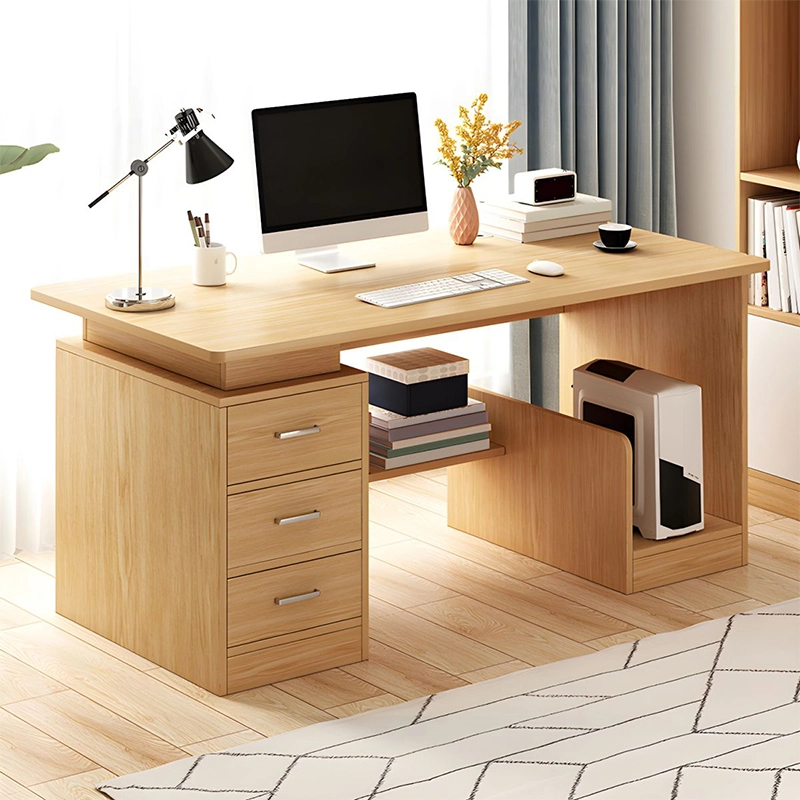
Wholesale Solid Wood Coworking Staff Desk—New Office Table with Drawers for Enterprise Staffs
As a trusted office desk wholesale supplier, we prioritize practicality: the desk is easy to assemble and rearrange, making it ideal for enterprises with flexible floor plans. The sturdy frame supports heavy use, and the natural wood finish is easy to clean and maintain. Whether you’re outfitting a large corporate team, a small department, or a shared coworking space, this desk delivers the right balance of functionality and style. For enterprises seeking adaptable, durable workstations that grow with their team, this wholesale solid wood desk is a smart, long-lasting investment.
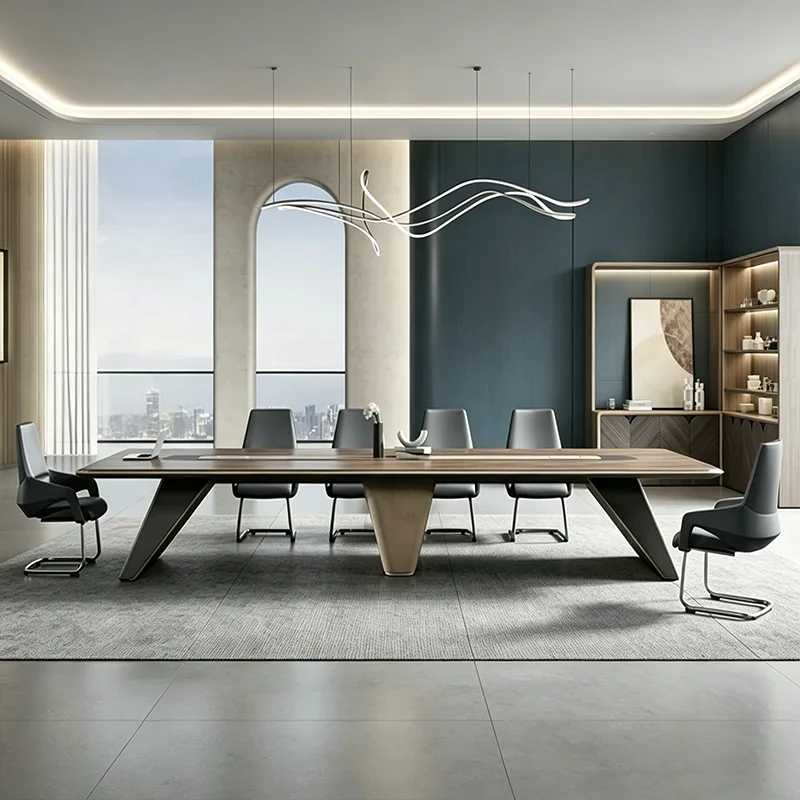
Modern Walnut Executive Conference Table with Cable Management & Custom Sizes
Designed for executive boardrooms, corporate meeting rooms and client presentation spaces, the MEI YI Furniture combines a long rounded walnut-look tabletop with architectural angled supports to create a refined professional centerpiece. Its spacious surface can be planned for different seating capacities, while the balanced three-support base gives the table a stable and distinctive profile.
A flush central cable-management channel helps organize power, data and meeting-room connections without disrupting the clean tabletop. The table can be configured in MDF or MFC with a durable wood-grain finish, with alternative finishes and power modules available according to project requirements.
Custom dimensions, colors, socket configurations, matching conference chairs, branding and packaging are available for commercial buyers, office furniture distributors and contract furnishing projects.

Modern Waiting Sofa for Reception Areas and Commercial Spaces
Modern Waiting Sofa Designed for High-Traffic Commercial Spaces
MEIYI's waiting sofa is engineered for commercial environments where comfort, durability and appearance are equally important.
Featuring premium teddy fabric upholstery, high-density foam cushioning and a reinforced internal frame, the sofa provides lasting support for visitors, clients and employees.
Create a welcoming and professional environment with MEIYI's modern waiting sofa. Designed for reception areas, office lobbies, clinics, hotels and commercial lounges, this waiting sofa combines ergonomic comfort, durable materials and customizable options to meet a variety of project requirements.Customizable sofas, featuring a teddy fabric cover that's durable and stain-resistant. Customizable sizes are also available.

Commercial Hotel Curtain Wall System — Modern Architectural Facade Solution for Hospitality & Mixed-Use Development Projects
Want to get more of our articles?
Contact one of our sales representatives or fill out this form.
MEI YI Furniture provides a one-stop service for the design, manufacturing, and customization of office, hotel, and school furniture.
Contact: Asya
Email: asya@myofficefurniture.com.cn
WhatsApp: +86 134 2216 1319
Address: No. 25, Nan Street, Jinpan, Zhongluotan Town, Baiyun District, Guangzhou, China.
Whatsapp: +8613422161319
Fackbook
Instagram
YouTube